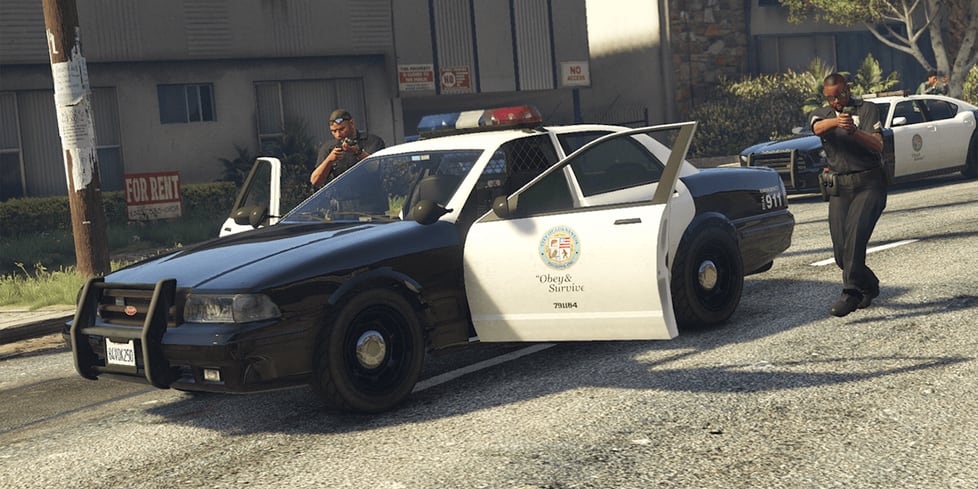
A clean turn can interrupt a police chase, but the route beyond that corner deserves just as much attention. In GTA 6, a well-timed maneuver that makes a pursuing car miss a turn or spin out can create an escape window. Use that opening to reach a less exposed position rather than stopping at the first available obstruction.
For players researching GTA 6 Accounts before starting, police evasion is a useful skill to study separately from vehicle speed or progression. Practice judging corners, checking exits, and choosing a destination before committing to a shortcut. Those decisions give an escape attempt a clear direction.
The recommendations below distinguish confirmed police behavior from practical route-planning advice. Suggested hiding locations are places to evaluate, not verified safe zones. No specific building, tunnel, parking structure, or roadside position is presented as a guaranteed way to end a search.
Break the Pursuit without Losing Control
Use corners to create an opening
Rockstar has described a system that rewards successful actions that disrupt pursuing officers, including maneuvers that cause police vehicles to overshoot corners. That supports a controlled approach to turning, not the assumption that every abrupt change of direction will work.
Before taking a turn, check what follows it:
- Room to complete the maneuver: Avoid an entrance too narrow for your current vehicle.
- A substantial obstruction: Look for a building or wall between your intended position and the approach behind you.
- A continuation route: Prefer a connection you can follow over a space you have not inspected.
- Space to recover: Leave yourself room to correct a poor approach without becoming wedged.
As a planning exercise, think two decisions ahead. Choose the corner, then identify where you would go if that corner only buys a short break.
Do not treat off-road driving as a pursuit barrier
Police can follow players through busy streets, against traffic, and off-road. Their available pursuit behaviors also include ramming, boxing vehicles in, blocking the route ahead, and shooting tires. Leaving the paved road therefore does not, by itself, remove the threat.
Before attempting an off-road shortcut, inspect the departure and return points. Avoid committing to an unfamiliar slope simply because it leads away from traffic. If the route damages your mobility or leaves you facing a barrier, it has not improved your escape position.
Pick a Hiding Position You Can Leave
A hiding position should have a clear purpose. Use it to reduce exposure while you assess the situation, not as an excuse to abandon route planning.
Evaluate potential locations against the same questions: What screens the approach? Who could see the entrance? Where would you leave?
| Potential location | Check before entering | Reason to choose another route |
| Behind a large building | Visibility from adjoining streets and side entrances | The opposite side opens directly onto another road |
| Connecting alley | Whether the passage continues and accommodates your vehicle | A gate or narrow obstruction blocks the exit |
| Recessed parking area | Turning space and visibility through the entrance | Leaving requires a slow, awkward reverse |
| Covered passage | Accessibility and a usable departure route | You cannot inspect what lies beyond it |
| Roadside recess | Separation from traffic and room to rejoin safely | The position remains exposed to passing vehicles |
These are inspection criteria, not location-specific concealment bonuses. Do not assign a detection reduction to shade, vegetation, roofs, or parked vehicles without reliable evidence.
Position for departure before settling
If you choose to pause in a location, try to avoid leaving your vehicle pointed into a wall or narrow corner. Check whether you can depart without a lengthy turn.
The same principle applies on foot. Before entering an enclosed space, identify the way out. A secluded yard may offer fewer useful options than a less enclosed passage with a visible connection to another street.
Adjust the Route to the Surroundings
Dense streets: choose connections, not repeated loops
For an urban escape, plan around connected routes rather than a series of isolated turns. A proposed sequence might look like this:
- 1. Take a corner you can complete cleanly.
- 2. Inspect the next accessible connection.
- 3. Reject routes that immediately return you to the same exposed road.
- 4. Keep an alternative available if the preferred connection is blocked.
Treat this as a planning method, not a guaranteed evasion pattern. Repeating a familiar loop can become an automatic response. Ask whether each turn actually changes your position or merely brings you back to a place you have already left.
Open roads: choose where the fast section ends
Before accelerating along an open road, select a departure point. Look for a junction you can approach under control and a route beyond it that you can inspect.
Avoid making the exit decision at the last moment. A sudden turn into an unfamiliar driveway may trade an open road for a dead end. If you cannot judge the entrance safely, continue toward a more readable option.
On foot: select the destination before abandoning the vehicle
If you decide to leave a vehicle, choose where you intend to run before opening the door. Check for accessible passages and a continuation route rather than heading toward the nearest obstruction.
This is a tactical recommendation, not a claim that switching to foot travel clears police knowledge or guarantees concealment. Compare what you gain from the transition against what you give up, including mobility and protection.
Read the Search Instead of Guessing at a Timer
Use the awareness and threat feedback
GTA 6 removes police positions from the player’s radar and uses awareness and threat indicators to help players respond during evasion. Appearance or outfit changes are also part of the available evasion systems. Do not plan solely around habits based on visible police radar markers.
Once you reach a screened position, assess the feedback before choosing your next action:
- Pause when moving would require entering a route you have not checked.
- Relocate when your position leaves no useful response to an approaching threat.
- Continue departing when you have inspected a workable route away.
No universal waiting period is supplied here. Avoid treating a quiet moment as proof that the encounter has ended.
Keep hiding from becoming inaction
Police can deploy K9 units to flush players out when they remain too comfortable without taking decisive action. A stationary hiding strategy is therefore not a universal solution.
Prepare a departure while you still have time to think. Check the exit, position your vehicle if you are using one, and choose the route beyond the entrance. Do not spend the entire pause watching the approach while leaving your own departure unresolved.
Check the Decision That Exposed You
After an unsuccessful escape, review the moment your options narrowed. Did you crash after creating an opening? Enter an enclosed space without checking its exit? Leave a screened position for a road you had not inspected? Use the answer to change one part of the next attempt rather than repeating the entire route at higher speed.
Players arriving through searches for cheap GTA 6 Accounts should apply the same evidence standard to escape claims: an account listing is not proof of a police-clearing trick. Look for demonstrated behavior, and keep unverified shortcuts separate from tactics you can test during play.
Before pulling out of a hiding position, identify your next turn and the route beyond it. If either is blocked or unclear, reconsider the departure while you still have room to choose.